Be the source AI answers are built from
Customers now ask ChatGPT, Perplexity, and Google's AI who they should hire, and those engines answer by citing a handful of sources. AI Visibility is the service that makes your business easy for them to find, understand, and cite, delivered by FirstCoast.ai together with Mulberry Marketing Communications.
The Snapshot is a real analysis of how your site shows up in AI answers today. Delivered within one business day, free, no obligation.
The answer is the new front page
Ranking on a page of blue links is no longer the whole game. AI Visibility is being the source an answer gets built from: read, trusted, quoted, and recommended by ChatGPT, Claude, Perplexity, Copilot, and Google's AI Overviews, even when nobody ever clicks through to your site.
- Buyers ask the engines directly: "who should we use for X" now gets an answer, not a list of ten links to compare
- Answers cite few sources: an engine builds its reply from a handful of pages it can access, parse, and trust
- The cited sources win: being quoted in the answer matters even when nobody clicks through to your site
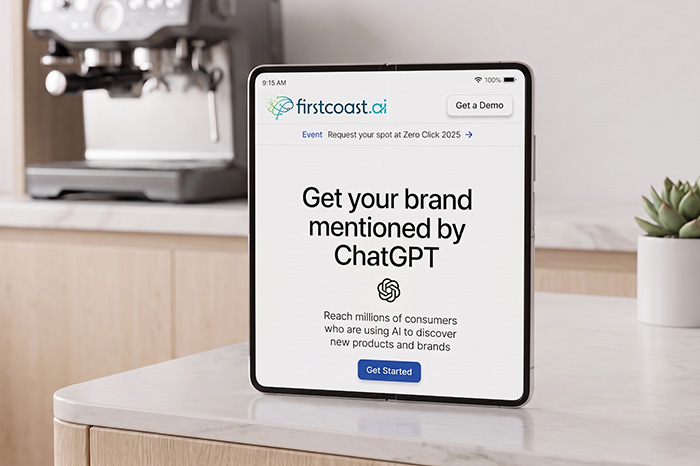
What makes up our AI Visibility service
- GEO: Generative Engine Optimization
- Getting your business into the answer itself, not just linked beside it: shaping your content so tools like ChatGPT, Perplexity, and Copilot draw on it and name you when they write a reply. Sometimes written as GSO (Generative Search Optimization).
Examples
- ChatGPT writes a paragraph about your industry and links your article as its source
- Perplexity lists your pricing guide among the citations under its answer
- An AI answer repeats your service description almost word for word, with your name attached
- Google AI Overviews: the AI answer above Google's results
- The AI-written summary at the top of a Google search, rolled out in 2024 from the beta Google called Search Generative Experience (SGE) and often shortened to AIO. It now sits alongside the deeper AI Mode tab. It is the AI answer most buyers see first, and it cites a handful of sources it trusts.
Examples
- Google answers "best CRM for small law firms" with a written summary naming three options above the usual links
- The summary box at the top of the results cites your how-to article as one of its sources
- A buyer reads the AI answer, picks a name from it, and never scrolls down to the classic results
- SEO: Search Engine Optimization
- Improving your search engine rankings: competing for a position in the ranked list of links a search returns, where the reader still scans results and decides which one to open, so the click is the goal. Still the foundation the newer disciplines build on.
Examples
- Your bakery shows up third when someone Googles "wedding cakes Jacksonville"
- A guide you published two years ago still brings in visitors from search every week
- Your service page outranks a competitor for "HVAC repair near me"
- LLMO: Large Language Model Optimization
- The newest label, sometimes written as LLM SEO: making your business part of what models like ChatGPT, Claude, and Perplexity know and repeat, through both their training data and the live pages they retrieve while answering.
Examples
- Asked "who repairs industrial floor scrubbers in Ohio", the model names your company from what it already knows
- A model looks up your website mid-answer to double-check your services before naming you
- A buyer asks for alternatives to a big-name vendor and your brand is one of the names offered
- AEO: Answer Engine Optimization
- Targets the one direct response: featured snippets, voice assistants, "position zero". It predates the current AI engines and aims to be the single answer rather than an option in a list.
Examples
- Someone asks Siri or Alexa a question and the assistant reads out one answer, taken from your page
- The highlighted box above Google's results quotes your FAQ word for word
- A "People also ask" row expands and your page is the answer inside it
- AI Visibility: the whole job, in one service
- Structure, schema markup, verifiable facts, and the authority signals engines trust, so any engine, ranked or generative, can find you, understand what you do, and repeat it accurately. Every term above is a piece of it.
Examples
- A free Business Snapshot shows which AI engines can and cannot read your website today
- A trade article about your company gets picked up and cited by three different AI tools
- The monthly report shows your mentions and citations climbing quarter over quarter
The labels overlap, and the industry hasn't settled on where one ends and the next begins. We don't sell them separately: a site that's genuinely readable (clean structure, accurate markup, facts an engine can verify), backed by coverage in publications engines trust, is the thing all of them are asking for, and AI Visibility is all of them delivered as one service.
Honorable mentions: you may also see this work called GAIO (Generative AI Optimization), GEIO (Generative Engine Information Optimization), AIVO (AI Visibility Optimization), or simply "AI SEO". Different label, same job.
A technical shop and an earned-media firm, one program
Engines decide what to cite from two things: whether they can read your site, and whether credible third parties vouch for you. Independent analyses of AI answers keep finding the same pattern: the sources engines cite most are trade and specialist publications, not big-name outlets. That is why AI Visibility is delivered by two firms as one program. Neither an SEO shop nor a PR firm alone covers both halves.


What FirstCoast.ai brings
- Making sure AI can find youWe check that every major AI tool can actually reach and open your website, and fix it where they can’t.
- Labeling your business correctlyWe tag your services, location, and facts in a format AI reads accurately instead of guessing at.
- Fixing what AI can’t seeSome websites look fine to a person but are invisible to AI behind the scenes. We find and fix that gap.
- Tracking your progress every monthA plain-English report showing how often AI is mentioning your business, and whether that’s climbing.
What Mulberry brings
- Writing content AI wants to quoteArticles and expertise written the way AI tools actually pull from when composing an answer.
- Getting you into trusted publicationsStanding relationships with the trade press AI tools already lean on as credible sources.
- Earning real press mentionsCoverage other outlets choose to run, which carries more weight with AI than anything paid for.
- Keeping your story consistentThe same accurate story about your business everywhere AI might encounter it.
Start free, then decide
The path runs from a free snapshot to a paid diagnostic to an ongoing program, and every step gives you something you keep. Nothing obligates the next step.
Business Snapshot
Free. A real analysis of how your site shows up in AI answers today, plus crawler access and speed checks. Summary by email within one business day, and a short call walks through the findings.
AI Visibility Audit
The full six-layer diagnostic, run against your site and against the sources already being cited in your category. You get a prioritized fix list you own either way.
AI Visibility Retainer
The ongoing program: technical work from FirstCoast.ai, authority content and earned media from Mulberry, and a dashboard reporting what moved every month.
Six layers, ordered by leverage
The AI Visibility Audit works top-down: if the bots cannot reach your pages, nothing below that matters. Each layer produces specific findings and specific fixes.
Access and crawlability
Can AI search bots fetch your pages at all. Robots rules, CDN and firewall behavior, and sitemaps, checked bot by bot. This is the most common failure, and everything else depends on it.
Rendering
Most AI crawlers read raw HTML and never run JavaScript. We verify your core content exists in the served page itself, not only after a browser finishes loading it.
Content structure
Answer-first pages, one clear heading hierarchy, and self-contained sections. Engines quote chunks, not whole pages, so every section has to stand on its own.
Structured data
Schema markup that makes your organization, services, and FAQs machine-legible, validated before it ships. Malformed markup is worse than none.
Authority and trust
Named authors, honest dates, first-party evidence, and outbound citations. Engines weigh credibility when they choose what to cite, and these are the signals they can verify.
Measurement
A baseline of where you are cited today, which competitors are cited instead, and the monitoring stack to track citations, share of voice, and AI referral traffic over time.
What the program delivers every month
The retainer is contracted on deliverables you can point to, not on outcomes nobody controls.
- A visibility dashboard: citations, share of voice against named competitors, and AI referral traffic
- Technical fixes: schema, structure, and crawler-access work completed, not just recommended
- Authority content: articles written for your buyers, structured so engines can quote them
- Earned media: placements in the trade and specialist publications engines actually cite
- A quarterly strategy review: what moved, what changed in the engines, and what comes next
What we will not promise
No one can guarantee a citation or a ranking. AI answers are probabilistic and change between runs, and anyone promising a specific placement is selling something they do not control. This program is contracted on deliverables and measured on leading indicators: completed fixes, published content, secured placements, and the movement in citations and share of voice they produce.
Where this pays off fastest
The strongest fit is B2B companies in trade-heavy verticals, think facilities, industrial, manufacturing, and B2B tech, where buyers already ask AI tools who to use and where a focused earned-media program can reach the publications engines cite. Competition inside those answers is still low, which is exactly why the window matters. If that sounds like your market, the free Business Snapshot will show you where you stand today.
Questions we get asked
How is AI Visibility different from SEO?
SEO competes for a position in a ranked list of links, and it still matters. AI Visibility aims one step further: being the source an AI-generated answer is built from, cited and recommended even when nobody clicks a link. The two overlap heavily in practice, because the same clean structure and verifiable content feed both. The difference is where the work points: SEO optimizes for the click, AI Visibility optimizes for the citation.
What is the difference between the Business Snapshot and the AI Visibility Audit?
The Snapshot is the free preview: an automated look at how you show up in AI answers today, with crawler access and speed checks, delivered within one business day. The Audit is the full six-layer diagnostic: access, rendering, content structure, structured data, authority signals, and a measurement baseline, run against your site and your category, with a prioritized fix list you keep whether or not you continue into the retainer.
Who does what between FirstCoast.ai and Mulberry?
FirstCoast.ai delivers the technical layer: crawler access, rendering, structured data, and the measurement stack. Mulberry Marketing Communications delivers the content and earned-media layer: authority content, trade press coverage, and thought leadership. Engines weigh both what your site says and what credible third parties say about you, which is why the service is delivered as one program rather than two contracts.
How do you measure progress?
Against a baseline taken at the start: where you are cited, where competitors are cited instead, and what AI referral traffic reaches your site. The monthly dashboard tracks citations, share of voice, and referral traffic from there, alongside the completed work that drives them. We measure leading indicators and completed deliverables, because no one controls the engines themselves.
How long does an engagement run?
Long enough for accumulated authority to show up in answers. Citations respond to a body of accessible, credible content, not to a single fix, so this is an ongoing program rather than a one-time project. The initial term is set in your proposal, and the audit findings, the content, and the measurement baseline are yours from day one.
Find out where you stand in AI answers
The free Business Snapshot shows how the engines see you today. The audit maps exactly what to fix, and you own the findings either way.